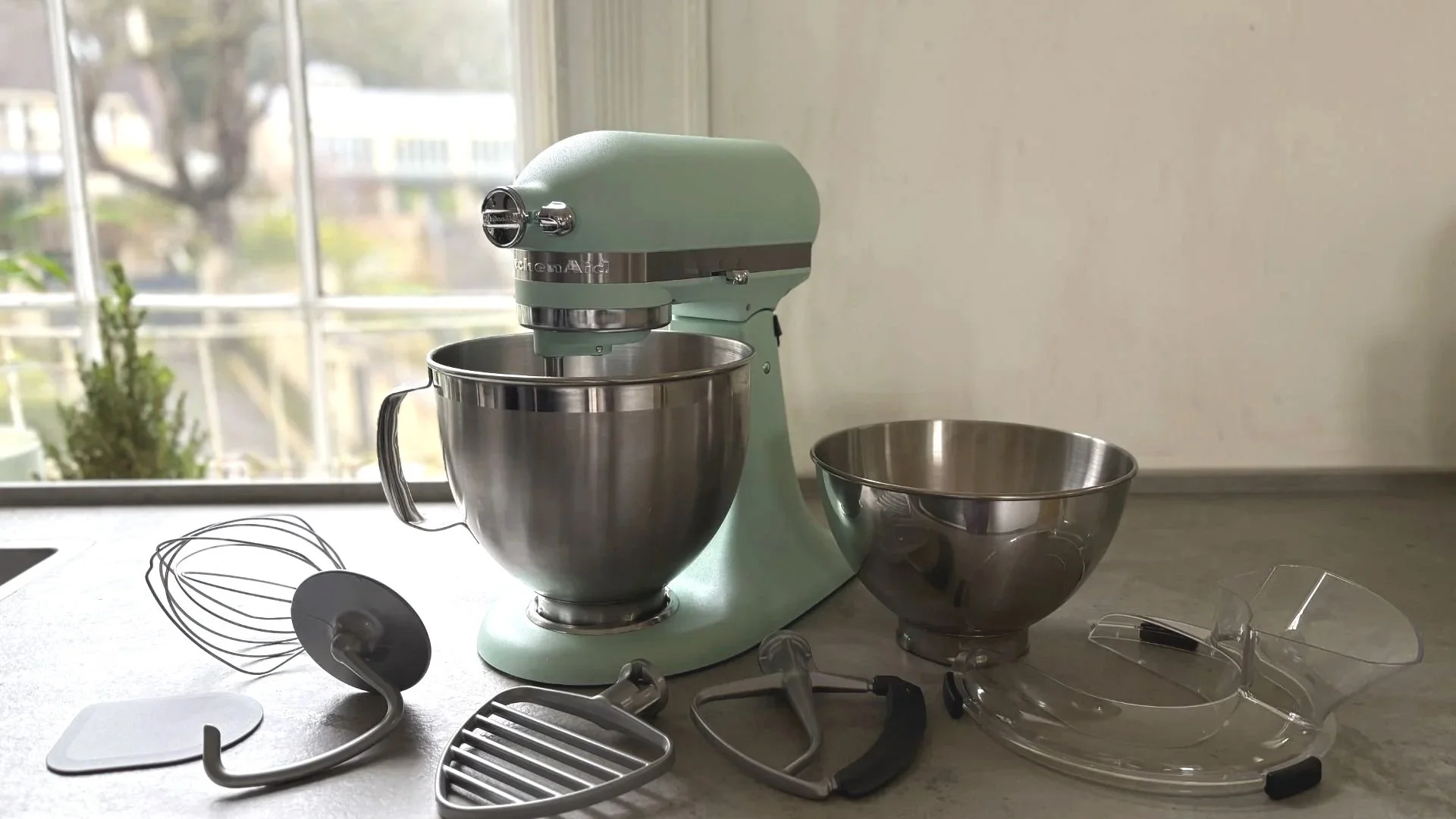
Usability Evaluation: KitchenAid Stand Mixer
Human factors study of setup confidence, safety, and feedback in a stand mixer.
Role: UX Researcher / Human Factors Evaluator
Methods: Cognitive Walkthrough | Heuristic Evaluation | User Interviews
Participants: 3 users
Timeline: Spring 2026
Focus: setup confidence, safety, and feedback cues
Overview
The KitchenAid stand mixer is a familiar and trusted tool for many bakers, but familiar products can still create usability issues when users are unsure whether parts are secure, how to move the product safely, or whether the system is ready to operate. I evaluated the mixer through a cognitive walkthrough, heuristic evaluation, and user interviews to identify where users lost confidence and what design changes could improve safety, feedback, and setup clarity.
Primary insight
Users found the mixer easy to operate once assembled, but setup and movement created uncertainty, safety concerns, and low confidence.
Cognitive Walkthrough
User Interviews
Task Flow Evaluated
Methods
Cross-Method Synthesis
Setup required guesswork, attachment security was unclear, and moving the mixer felt unsafe.
Recommendations
1. Add visual lock indicators
3. Add tactile or audible feedback
Observed 3 users with little to no KitchenAid experience as they completed setup and mixing tasks using a think-aloud protocol.
Move mixer to counter
Add ingredients
1. Setup lacked confirmation
Users were unsure whether the bowl and attachments were fully secured. The twisting and locking mechanisms were not immediately apparent, which caused hesitation during setup.
3. Operation was easier than assembly
Once assembled, users understood how to control the speed and head lock. The main usability gap appeared during setup, attachment security, and physical handling.
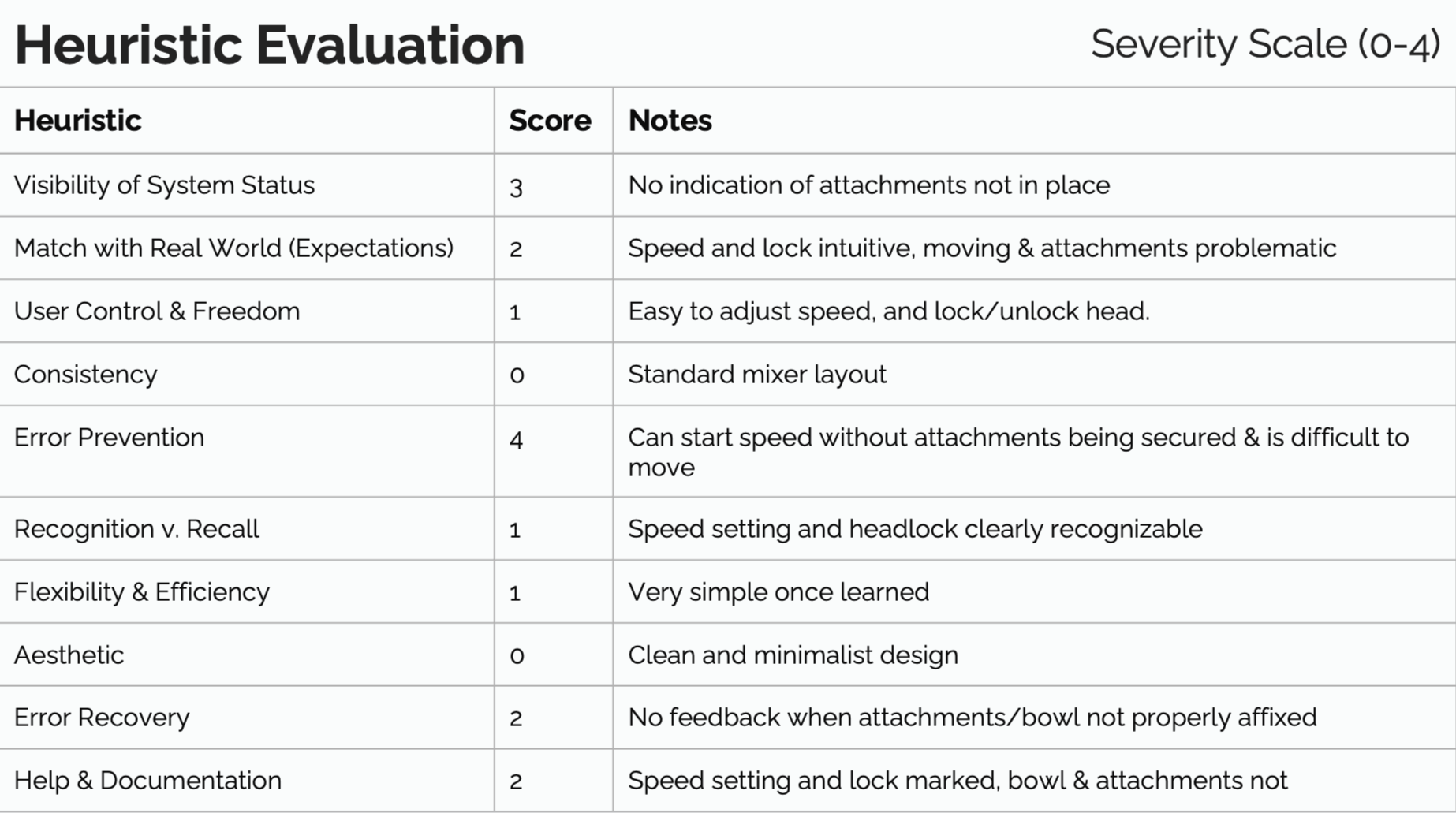
Evaluated the mixer using usability heuristics and a 0–4 severity scale to identify issues with feedback, error prevention, and guidance.
Heuristic Evaluation
→
Lock bowl
→
Start mixer
Key Findings
2. Add an interlock system
I compared this flow against the ideal setup process to identify where users hesitated, made errors, or lost confidence.
User Observation
2. Movement felt unsafe
One participant could not lift it without help, while another nearly dropped it after grabbing the head, not realizing the body could swing away.
4. Adding ingredients created mess
Across the cognitive walkthrough, heuristic evaluation, and user interviews, the same pattern appeared: users could operate the mixer once it was assembled, but they were not always confident that it was assembled safely. The speed control and head lock were recognizable, while the bowl, attachment, and movement steps required more guesswork.
What broke down
I used a 0–4 severity scale to evaluate where the mixer created usability risks around feedback, error prevention, and user confidence. The highest severity issue was Error Prevention, because the mixer can be started when parts may not be fully secured and can be difficult to move safely.
The evaluation also showed issues with Visibility of System Status and Error Recovery. Users were not given clear feedback when the bowl or attachment was not properly affixed, reinforcing the same pattern found in testing: the mixer was easy to operate, but harder to trust during setup.
Primary gap
The mixer needed clearer feedback on secure assembly and safer-handling cues during setup.
Based on the evaluation, I focused recommendations on improving setup confidence, secure assembly feedback, and safe handling during setup.
Show users when the bowl, attachment, and head are fully secured before use.
Prevent the mixer from starting if the bowl or attachment is not properly locked into place.
Use a clear click, snap, or tactile cue to confirm that parts are correctly attached.
Add handles or recessed grip indentations to show users where to safely hold the mixer when lifting or repositioning it.
This evaluation demonstrates how familiar and trusted products can still create uncertainty when physical feedback is unclear. Even when users can complete a task, hesitation and low confidence can reveal important usability gaps. In a future iteration, I would prototype the lock indicators, interlock behavior, tactile feedback, and grip affordances to test whether these changes improve setup confidence and perceived safety.
Reflection / Next Steps
Dry ingredients splashed out during mixing, reinforcing users’ concerns about control, safety, and whether the mixer was ready to use.
Heuristic Evaluation
What worked
Users understood the speed control and head lock after brief exploration.
Attach accessory
←
↓
Lock head
“I almost dropped it on my foot because I grabbed it by the head, and the body flung out.” –– Kim, 55
This moment revealed that the mixer’s physical form did not clearly communicate where it was safe to hold or whether the head was secure enough to move.
Asked users about ease of use, safety concerns, confidence cues, and setup and movement challenges.
4. Add safe-handling grips
←